Uber is a fast-growing company that serves as a unique alternative to traditional taxi service. Rather than try to hail a cab, one can simply request a ride through the Uber app. Independent Uber drivers then see the request, and come pick you up. The process is safe, easy, and often cheaper than a taxi.
Uber is a remarkable new innovation that improves the lives of many Americans. Despite that, Democratic Presidential candidates Hillary Clinton and Bernie Sanders recently come out against it. Clinton starts off with paying lip service to the innovation that companies like Uber bring to the economy, but quickly switches to condemnation for their employment strategies.
Essentially, Uber treats all of their drivers as what they are: independent contractors. They are simply individuals willing to use give rides to others using Uber in exchange for money (which Uber takes a cut of), all done through the app. At no point in the process does Uber actually direct the drivers in any way. They are free to work as much or as little as they please, and take whatever jobs they see fit. If the drivers don't like it, they're free to quit at any time.
Hillary Clinton sees this arrangement, but ignores the mutual benefits between Uber, the drivers, and the passengers. Instead, she decries the lack of benefits and security that drivers have. She is correct that Uber doesn't offer maternity leave, but why should they have to? The vast majority of Uber drivers are happy to work under the conditions they are offered, so why should regulators have to step in to fix a perceived problem?
Clinton is not alone. Senator Bernie Sanders agrees, citing serious problems with Uber due to a "lack of regulation". Both Sanders and Clinton profess to want more jobs and more economic growth in America. Uber is a quintessential American innovation, using technological advances to offer a superior product. Their opposition to this speaks volumes to their economic ignorance.
New York Mayor Bill de Blasio recently tried to cap the number of Uber drivers in New York City, citing similar fears to Clinton and Sanders. He dropped the plan after a the public outcry against the proposed scheme, which was widely perceived to benefit only the city-licensed cab drivers, and not the people of New York City.
Many politicians on the left who attack Uber miss the point. Uber provides quick, quality service that benefits both the driver and the passenger. It is a perfect example of a market innovation that improves the lives of people across the nation. Clinton should be praising Uber, not attacking them.
The market created Uber, and politicians are trying to destroy it.
"Reject all systems, and try liberty - liberty, which is an act of faith in God and in His work." - Frédéric Bastiat
Showing posts with label economic freedom. Show all posts
Tuesday, August 11, 2015
Freedom of Contract and Self Interest
Freedom of contract is the principle that two parties can voluntarily enter into an economic agreement that they both deem mutually beneficial. In other words, people are free to make agreements regarding working conditions that all parties find acceptable.
Freedom of contract hardly exists today. For example, OSHA currently mandates such specific requirements like mandatory minimum lighting requirements. One of the most wide reaching set of regulations is the Fair Labor Standards Act, which mandates the now commonplace overtime pay requirements, child labor laws, and more.
These regulations were ostensibly enacted to ensure "fair" labor conditions (according to the arbitrary standard set by the bureaucrats, of course), and protect workers. There's nothing inherently wrong with the standards themselves. The real harm comes with the one-size-fits-all mandate.
Suppose there's a seventeen year old looking for work. He happens to be an expert in meat processing, and interviews for a job in the meat department at a grocery store. He is shocked when he's told that it's illegal for him to operate any meat processing machines at work, because it's unsafe. He leaves dejected and unemployed.
In this scenario, the grocery store loses a skilled and willing worker, and the young man loses a job. Neither party used force against the other. The beauty of freedom of contract is that it requires voluntary action from everyone involved before anything actually happens.
Labor regulations impose an arbitrary standard of fairness on millions of people with different wants, needs, and standards. What's fair to one worker may not be to another, and with the freedom of contract, that's okay. Every worker can seek a job where the standards and conditions fit with what they personally are looking for.
There's a common fear that if these standards were removed, some companies would take advantage of their newfound freedom and abuse workers with deplorable conditions, hours, and pay. This fear ignores the crucial motivator; self-interest. Henry Ford famously payed his employees the (at the time) exorbitant wage of $5 a day, far more than anyone else was offering. His reasoning was simple. The more he pays, the more likely he is to both attract and maintain the highest skilled workers for his factories.
Nobody forced Ford to pay a higher wage. He benefitted, and so did his workers. Self interest motivates businesses to keep working conditions at a place their employees want. If they start to fall, the workers will seek employment elsewhere. Even if they would rather cut corners on safety and wages, their own desire to stay in business and make a profit forces them to keep things at an acceptable level.
Adam Smith wrote in The Wealth of Nations that "It is not from the benevolence of the butcher, the brewer, or the baker that we expect our dinner, but from their regard to their own self interest." He demonstrates with this example that self interest is an incredibly powerful guiding force that ultimately tends to yield socially beneficial outcomes. This is why freedom of contract works. Regulations simply get in the way.
Freedom of contract hardly exists today. For example, OSHA currently mandates such specific requirements like mandatory minimum lighting requirements. One of the most wide reaching set of regulations is the Fair Labor Standards Act, which mandates the now commonplace overtime pay requirements, child labor laws, and more.
These regulations were ostensibly enacted to ensure "fair" labor conditions (according to the arbitrary standard set by the bureaucrats, of course), and protect workers. There's nothing inherently wrong with the standards themselves. The real harm comes with the one-size-fits-all mandate.
Suppose there's a seventeen year old looking for work. He happens to be an expert in meat processing, and interviews for a job in the meat department at a grocery store. He is shocked when he's told that it's illegal for him to operate any meat processing machines at work, because it's unsafe. He leaves dejected and unemployed.
In this scenario, the grocery store loses a skilled and willing worker, and the young man loses a job. Neither party used force against the other. The beauty of freedom of contract is that it requires voluntary action from everyone involved before anything actually happens.
Labor regulations impose an arbitrary standard of fairness on millions of people with different wants, needs, and standards. What's fair to one worker may not be to another, and with the freedom of contract, that's okay. Every worker can seek a job where the standards and conditions fit with what they personally are looking for.
There's a common fear that if these standards were removed, some companies would take advantage of their newfound freedom and abuse workers with deplorable conditions, hours, and pay. This fear ignores the crucial motivator; self-interest. Henry Ford famously payed his employees the (at the time) exorbitant wage of $5 a day, far more than anyone else was offering. His reasoning was simple. The more he pays, the more likely he is to both attract and maintain the highest skilled workers for his factories.
Nobody forced Ford to pay a higher wage. He benefitted, and so did his workers. Self interest motivates businesses to keep working conditions at a place their employees want. If they start to fall, the workers will seek employment elsewhere. Even if they would rather cut corners on safety and wages, their own desire to stay in business and make a profit forces them to keep things at an acceptable level.
Adam Smith wrote in The Wealth of Nations that "It is not from the benevolence of the butcher, the brewer, or the baker that we expect our dinner, but from their regard to their own self interest." He demonstrates with this example that self interest is an incredibly powerful guiding force that ultimately tends to yield socially beneficial outcomes. This is why freedom of contract works. Regulations simply get in the way.
Monday, August 10, 2015
Bernie Sanders' Agenda for America: 12 Steps Backwards Part 2
Senator Bernie Sanders' policy proposal, the "Agenda for America", is billed as 12 Steps Forward. In it, he details his proposed economic reforms. The proposal covers the standard run of social democrat talking points: more government growth, more intrusion into markets, and more onerous regulations.
This is a continuation of an item-by-item rebuttal of the Agenda for America (You can find Part 1 here)
7. Trade Policies that Benefit American Workers
Sanders continues his assault on the free market by attacking various free (or at least free-ish) trade policies such as NAFTA, which he dubs "disastrous". He is more explicit in his condemnation of free trade policies here. For Sanders, the issue is simple. American manufacturing jobs are "moving overseas" and this must be stopped at all costs.
Again, Sanders falls prey to yet another economic fallacy: economic nationalism (or, at the very least, an anti-foreign bias). Sanders cites the 4.9 million manufacturing jobs lost with the growth of more manufacturing overseas, but he fails to note all the other jobs that were created in the same timeframe. Sanders is not alone in his constant reiteration that America, for some reason, NEEDS manufacturing jobs.
The reason that there are greater numbers of factories located outside of America is simple: they're cheaper. The cheaper it is to produce a good, the cheaper that good can be sold for. Sanders is in effect advocating for higher prices nationwide (which isn't ideal for the American working class he claims to represent). The whole point serves as a convenient condemnation of two of Sanders' greatest foes: corporations and foreigners.
8. Making College Affordable for All
Though this is nominally about higher education, Sanders elaborates that he thinks America needs a complete educational overhaul. He believes that not only college, but also "quality child care" should be made "affordable" for all. Presumably, he means to lower the direct cost to the consumer through heavy subsidies.
Forbes has an excellent write-up that details how subsidies actually raise the price of college. Sanders' proposal would be at best counterproductive, and at worse, a major contribution to the mountains of debt that many students already find themselves under. Even pushing that aside, to subsidize education on this scale would necessitate a tremendous amount of increased government spending, complicated tax incentives, and likely increased taxation.
But hey, it sounds nice, doesn't it? And isn't that what really counts?
9. Taking on Wall Street
By this, Sanders means to "break up" large financial institutions, as they are "too powerful" to be reformed. He blames them solely for the Great Recession, and implies that their power and lack of regulation is a danger to us all.
The second point is laughable. The financial sector of the economy is among the most highly regulated in the nation, subject to the jurisdiction of a plethora of financial regulators (at both the state and the federal level). I applaud Sanders for attempting to address cronyism, but he misses the mark here.
Moreover, Sanders fears these financial institutions for their size alone. Even if he didn't blame them for the financial crisis, he'd still want to break them up and regulate them purely for being too big for his liking. Never mind the fact that these large financial institutions behave in such a risky manner because they've been trained to. By that I mean, there is the expectation that the government will always step in to bail them out if things go too far. This creates a moral hazard problem, where the risk is decreased because it is being borne by an outside party (the government), so banks feel free to risk as much as they want.
As always, Sanders only sees one side of the issue, and ignores the federal government's role in the problems he crusades so strongly against.
10. Health Care as a Right for All
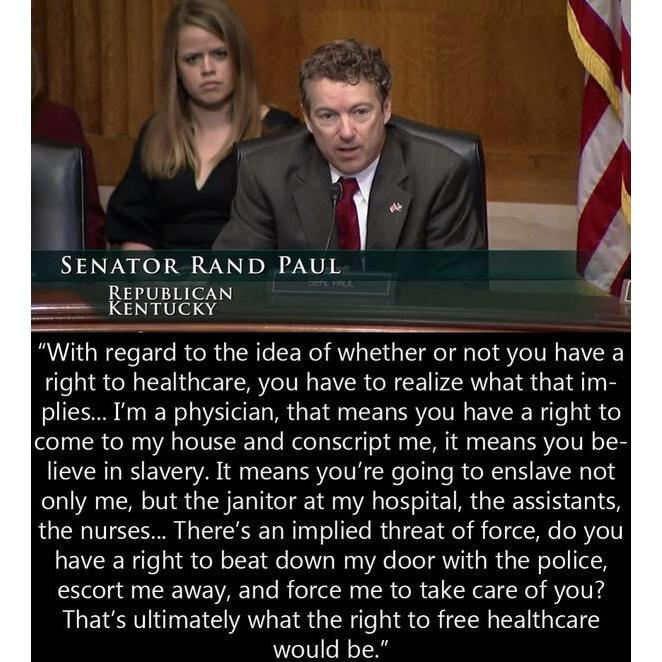
Rand Paul said this better than I ever will. Sanders believes that there ought to be rights that obligate people to receive certain things at the behest of the federal government, rather than the understanding that rights exist to restrict what the government can do against the individual.
11. Protecting the Most Vulnerable Americans
America is in debt. Trillions and trillions of dollars worth of debt. Unfunded mandates are programs the federal government is obligated to pay for (such as Social Security or Medicaid), but lacks the money in the coffers to address it. These unfunded mandates measure in the hundreds of trillions of dollars, far in excess of the already massive federal debt.
Sanders doesn't care about the looming debt crisis. Instead, he calls for massive expansions to these programs. The cost is irrelevant to him. He believes that the key to alleviating poverty is through the hands of the federal government.
In 1964, Lyndon Johnson began the "War on Poverty", a series of legislative actions and social programs designed the end poverty in the United States. Fifty-one years later, poverty is still here. The only difference is the trillions of dollars spent trying to get rid of it. Poverty is not something that the federal government can ultimately vanquish.
An end to poverty comes from the millions of Americans working every day to create businesses, to expand wealth, and to invent new labor-saving technology. The market has freed more people from poverty than the government ever will.
12. Real Tax Reform
This is the crux of the matter. Sanders has so far outlined a massive spending program the likes have which have never been seen before in America. Trillions of dollars spent attempting to alleviate every perceived social ill that he can imagine, without a word of how to pay for it. Until now.
Sanders' idea of real tax reform toes his own party line: tax "the rich". As much as possible. Increase taxes on corporations, increase taxes on the wealthy, increase taxes all across the board.
Taxation has a negative effect on the creation of wealth. A progressive tax rate effectively punishes success. The more value you create, the more people you help, the better you do for your fellow man in an economy (as measured by your own wealth), the more the government takes away from you. Under this plan, enterprising young workers would pour out of the country. Businesses would flee to less restrictive regimes. Unemployment would rise. Growth would fall.
For Sanders, this would be justification of his whole plan. The corporations would be at fault, the foreign governments that offer less financially oppressive regimes would be at fault. Certainly not the federal government! All Sanders wants to do is help the people out.
Sanders may have the best of intentions with his ambitious "Agenda for America", but he would ultimately hurt workers, the economy, and the country more than he would help.
7. Trade Policies that Benefit American Workers
Sanders continues his assault on the free market by attacking various free (or at least free-ish) trade policies such as NAFTA, which he dubs "disastrous". He is more explicit in his condemnation of free trade policies here. For Sanders, the issue is simple. American manufacturing jobs are "moving overseas" and this must be stopped at all costs.
Again, Sanders falls prey to yet another economic fallacy: economic nationalism (or, at the very least, an anti-foreign bias). Sanders cites the 4.9 million manufacturing jobs lost with the growth of more manufacturing overseas, but he fails to note all the other jobs that were created in the same timeframe. Sanders is not alone in his constant reiteration that America, for some reason, NEEDS manufacturing jobs.
The reason that there are greater numbers of factories located outside of America is simple: they're cheaper. The cheaper it is to produce a good, the cheaper that good can be sold for. Sanders is in effect advocating for higher prices nationwide (which isn't ideal for the American working class he claims to represent). The whole point serves as a convenient condemnation of two of Sanders' greatest foes: corporations and foreigners.
8. Making College Affordable for All
Though this is nominally about higher education, Sanders elaborates that he thinks America needs a complete educational overhaul. He believes that not only college, but also "quality child care" should be made "affordable" for all. Presumably, he means to lower the direct cost to the consumer through heavy subsidies.
Forbes has an excellent write-up that details how subsidies actually raise the price of college. Sanders' proposal would be at best counterproductive, and at worse, a major contribution to the mountains of debt that many students already find themselves under. Even pushing that aside, to subsidize education on this scale would necessitate a tremendous amount of increased government spending, complicated tax incentives, and likely increased taxation.
But hey, it sounds nice, doesn't it? And isn't that what really counts?
9. Taking on Wall Street
By this, Sanders means to "break up" large financial institutions, as they are "too powerful" to be reformed. He blames them solely for the Great Recession, and implies that their power and lack of regulation is a danger to us all.
The second point is laughable. The financial sector of the economy is among the most highly regulated in the nation, subject to the jurisdiction of a plethora of financial regulators (at both the state and the federal level). I applaud Sanders for attempting to address cronyism, but he misses the mark here.
Moreover, Sanders fears these financial institutions for their size alone. Even if he didn't blame them for the financial crisis, he'd still want to break them up and regulate them purely for being too big for his liking. Never mind the fact that these large financial institutions behave in such a risky manner because they've been trained to. By that I mean, there is the expectation that the government will always step in to bail them out if things go too far. This creates a moral hazard problem, where the risk is decreased because it is being borne by an outside party (the government), so banks feel free to risk as much as they want.
As always, Sanders only sees one side of the issue, and ignores the federal government's role in the problems he crusades so strongly against.
10. Health Care as a Right for All
Rand Paul said this better than I ever will. Sanders believes that there ought to be rights that obligate people to receive certain things at the behest of the federal government, rather than the understanding that rights exist to restrict what the government can do against the individual.
11. Protecting the Most Vulnerable Americans
America is in debt. Trillions and trillions of dollars worth of debt. Unfunded mandates are programs the federal government is obligated to pay for (such as Social Security or Medicaid), but lacks the money in the coffers to address it. These unfunded mandates measure in the hundreds of trillions of dollars, far in excess of the already massive federal debt.
Sanders doesn't care about the looming debt crisis. Instead, he calls for massive expansions to these programs. The cost is irrelevant to him. He believes that the key to alleviating poverty is through the hands of the federal government.
In 1964, Lyndon Johnson began the "War on Poverty", a series of legislative actions and social programs designed the end poverty in the United States. Fifty-one years later, poverty is still here. The only difference is the trillions of dollars spent trying to get rid of it. Poverty is not something that the federal government can ultimately vanquish.
An end to poverty comes from the millions of Americans working every day to create businesses, to expand wealth, and to invent new labor-saving technology. The market has freed more people from poverty than the government ever will.
12. Real Tax Reform
This is the crux of the matter. Sanders has so far outlined a massive spending program the likes have which have never been seen before in America. Trillions of dollars spent attempting to alleviate every perceived social ill that he can imagine, without a word of how to pay for it. Until now.
Sanders' idea of real tax reform toes his own party line: tax "the rich". As much as possible. Increase taxes on corporations, increase taxes on the wealthy, increase taxes all across the board.
Taxation has a negative effect on the creation of wealth. A progressive tax rate effectively punishes success. The more value you create, the more people you help, the better you do for your fellow man in an economy (as measured by your own wealth), the more the government takes away from you. Under this plan, enterprising young workers would pour out of the country. Businesses would flee to less restrictive regimes. Unemployment would rise. Growth would fall.
For Sanders, this would be justification of his whole plan. The corporations would be at fault, the foreign governments that offer less financially oppressive regimes would be at fault. Certainly not the federal government! All Sanders wants to do is help the people out.
Sanders may have the best of intentions with his ambitious "Agenda for America", but he would ultimately hurt workers, the economy, and the country more than he would help.
Subscribe to:
Posts (Atom)